 Disney Tips Your Guide To A Great Disney Vacation

For the millions of guests who have glided over the treetops of Walt Disney World since 2019, the Disney Skyliner is more than just transportation—it’s a highlight of the vacation. It’s fast, it’s breezy, and it offers a bird’s-eye view of the “Most Magical Place on Earth.” However, as Disney moves into February 2026 and begins breaking ground on massive expansions such as Villains Land and Tropical Americas, fan demand for more gondolas is louder than ever.

“Why doesn’t it go to the Magic Kingdom?” “Why are the All-Star resorts still stuck with just buses?” “When are we getting a line to Animal Kingdom?”
While the public is looking up at the sky, Disney’s Imagineers and financial analysts are looking at the math, the geography, and the weather. Despite the $60 billion investment plan currently underway across the parks, a Skyliner expansion remains the “impossible ask.” From astronomical infrastructure costs to the terrifying logistics of Florida lightning, here is the deep dive into the “Invisible Walls” preventing the Skyliner from ever leaving its current loop.
1. The Multi-Million Dollar “Bargain”
The first and most obvious hurdle is the price tag. While gondola systems are often touted as a “cheaper” alternative to the legendary Monorail, those figures are relative.

- The Monorail: Costs upwards of $100 million per mile to build in 2026.
- The Skyliner: Initially cost an estimated $15 million to $20 million per mile, which sounds like a bargain until you factor in the massive, specialized stations.
The Return on Investment (ROI) Problem
Disney is a business driven by ROI. The current Skyliner serves four specific hotels, effectively justifying higher room rates for “Value” resorts like Pop Century. Expanding the line to Animal Kingdom would require miles of infrastructure through undeveloped conservation land. This massive expenditure wouldn’t necessarily sell more hotel rooms; it would just make the commute easier for guests who are already paying for them. For Disney’s bean-counters, spending $200 million for “convenience” with no direct revenue stream is a hard sell.
2. The Lightning Capital of the World
Central Florida is famously the Lightning Capital of North America. For a transportation system that consists of metal boxes suspended 60 feet in the air by a steel cable, this is a significant operational nightmare.
The “Double-Fleet” Logistical Burden
Disney operates under strict safety protocols. If lightning is detected within a 10-mile radius, the Skyliner must begin a staged shutdown.
- The Evacuation: All cabins must be cleared of guests, often taking 20–30 minutes.
- The Redundancy: Disney must maintain a full fleet of buses to cover the route at a moment’s notice when the sky turns gray.
If Disney expanded the Skyliner to the Magic Kingdom, they wouldn’t be replacing the buses; they would be paying to maintain two separate transportation systems simultaneously, because they cannot rely on the Skyliner during frequent Florida summer storms.
3. The “Hot Box” and passive Ventilation
One of the most frequent complaints from guests—and a primary reason the system hasn’t expanded to longer routes—is the lack of Air Conditioning.

The Skyliner cabins are cooled via “passive ventilation,” meaning they stay cool only while in motion. In the mid-day Florida heat, these cabins can reach 95–100°F if they stop moving.
- Weight Issues: Adding A/C units and the batteries required to power them would add thousands of pounds to the line, requiring thicker cables, stronger towers, and larger motors.
- The Standoff Risk: Currently, most Skyliner trips are under 12 minutes. Guests can tolerate the heat for 12 minutes. A journey to a further-flung park could take 25–30 minutes, turning a mechanical stall into a dangerous medical liability for heat exhaustion.
4. The Geographic and Infrastructure Nightmare
Looking at a map of Walt Disney World, it seems easy to just “draw a line” between parks. In reality, the 25,000-acre resort is a maze of infrastructure.

- World Drive: Extending the line toward the Magic Kingdom would require towers high enough to clear major multi-lane highways and high-voltage power lines.
- The Animal Kingdom “No-Fly Zone”: Imagineers are protective of the animal enclosures. The noise of a massive mechanical cable and the visual of gondolas gliding over the savanna could stress the elephants, rhinos, and giraffes. To avoid the animals, the route would have to be so circuitous that a bus would be significantly faster.
5. The Aesthetic of the “Deluxe” Experience
Disney’s “Deluxe” resorts, such as the Grand Floridian or Animal Kingdom Lodge, are built on a foundation of total immersion. Guests pay $800+ a night to feel like they are in a Victorian estate or a South African safari.
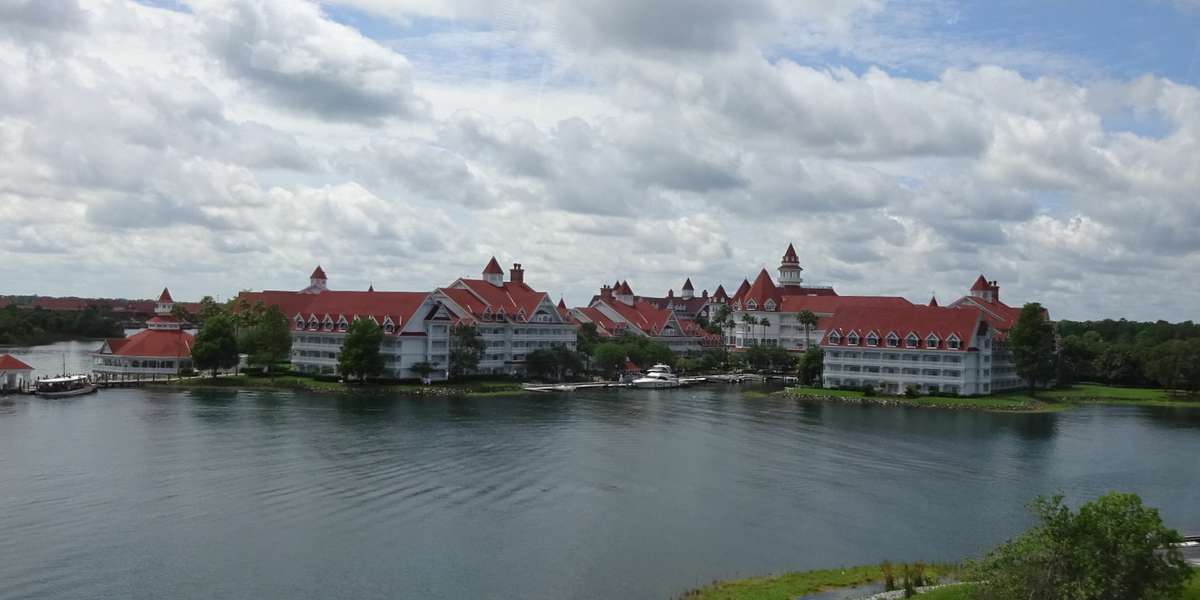
A Skyliner station, which resembles a high-tech ski lift, is a major “thematic break.” Imagineers are loath to cut the iconic skyline of the Grand Floridian with steel cables and colored gondolas. For these high-end resorts, the “Old World” charm of boats and the “Futuristic” legacy of the Monorail are protected as part of the brand.
6. The Future is Grounded: Autonomous Shuttles
While fans are looking up at the sky, Disney is looking down at the road. The future of Disney transportation in 2026 isn’t in the air; it’s in Autonomous Electric Shuttles.

Technology is rapidly reaching a point where Disney can deploy a fleet of self-driving, air-conditioned mini-buses. These vehicles:
- Don’t require multi-million dollar towers or cables.
- Can operate in lightning and heavy rain.
- Can be rerouted instantly based on crowd levels or resort demand.
Conclusion: A Masterpiece in a Small Box
The Disney Skyliner is a triumph of modern theme park design, but it is also a closed loop. It works perfectly for the EPCOT resort area, connecting four hotels and two parks in a scenic, efficient way. But for the rest of the resort, the “Invisible Walls” are simply too high to climb.
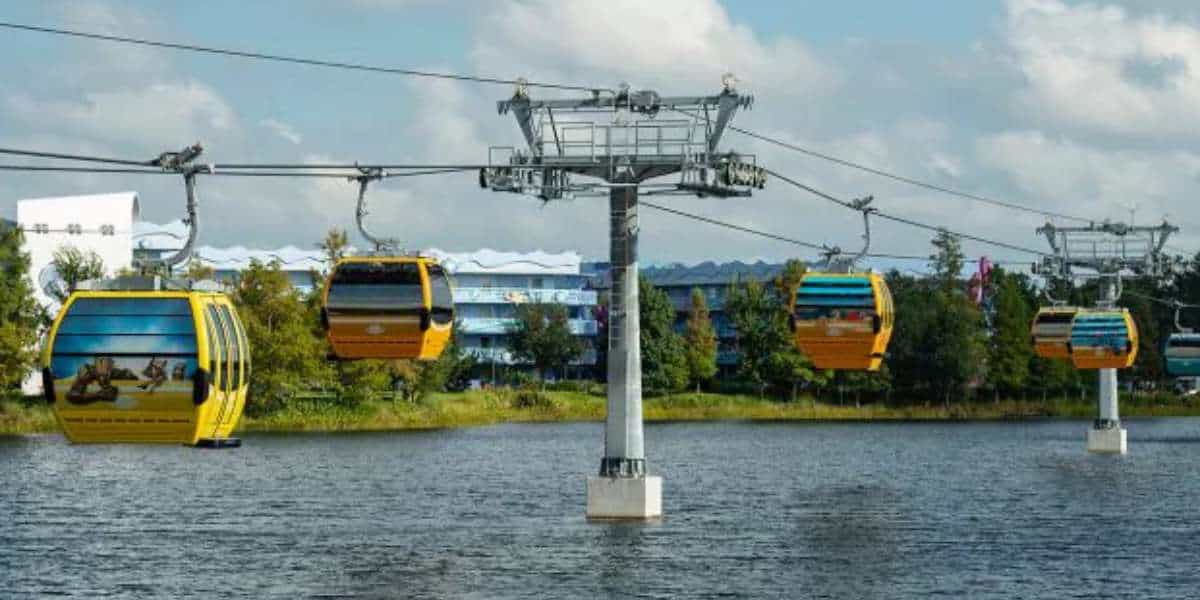
As Disney moves forward with its 2026 expansion plans, including the reimagining of Hollywood Studios and the construction of Villains Land, don’t expect to see those gondolas gliding toward the Magic Kingdom. The sky, it seems, has its limits.
Would you rather see Disney spend $200 million on a Skyliner expansion or on a brand-new fifth theme park? Let us know in the comments below!