 Disney Tips Your Guide To A Great Disney Vacation

For over half a century, the phrase “Disney trip” evoked a specific image: a middle-class family, a double stroller, and a child’s first meeting with Mickey Mouse. But as we navigate the landscape of May 2026, that image is being replaced.
Today, the “Magic Kingdom” is increasingly populated by “DINKs” (Double Income, No Kids) and “Disney Adults” who treat the parks less like a playground and more like a high-end, all-inclusive resort.

Recent investigations by the LA Times and Deseret News have highlighted an uncomfortable truth: Disney has realized that adults without children are their most profitable demographic, and the parks are being redesigned to reflect that reality.
The Pricing Barrier: A “Family Tax” in Disguise
The most significant shift is the financial wall. As Deseret News recently explored, the “family budget” version of a Disney vacation has effectively gone extinct. In 2026, a family of four can expect to spend more on a five-day trip than they would on a used car.

The move to a “pay-to-play” mode — specifically with the Lightning Lane Premier Pass — has created a class system within the parks. A childless couple can easily justify spending an extra $100 per person to skip the lines and make the most of their day. For a family of five, that’s a $500 daily surcharge. By turning convenience into a luxury, Disney is effectively telling middle-class parents that their children’s comfort is available only to those with executive-level salaries.
Thrills and Tech: The New Attraction Standard
It’s not just the tickets; it’s the rides. The LA Times recently noted that Disney’s “obsession” with the adult demographic is manifesting in its attraction design. The newest heavy-hitters—like TRON Lightcycle / Run and Guardians of the Galaxy: Cosmic Rewind—are high-speed, high-intensity thrill rides.
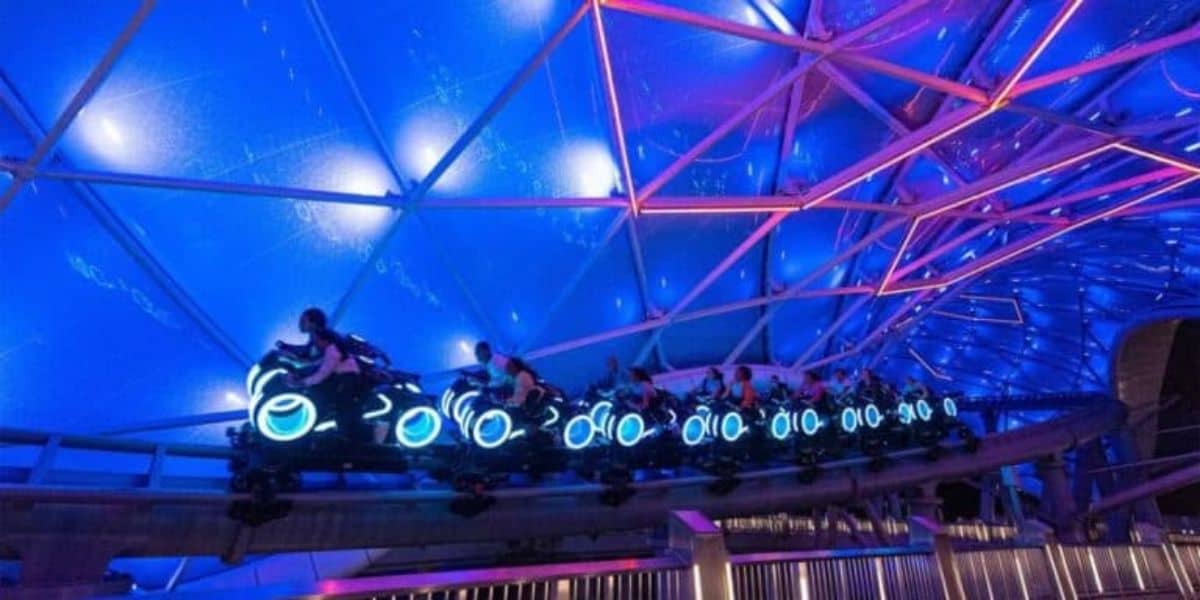
While these are technical triumphs, they aren’t for everyone. They feature strict height requirements and intensity levels that exclude the youngest guests. Furthermore, reliance on complex virtual queues and constant smartphone use favors the digitally savvy “super-fan” over the parent trying to manage three children and a diaper bag. The “all-ages” magic of the classic dark ride is being traded for “E-ticket” adrenaline designed to satisfy the adult thrill-seeker.
The Gastropub Kingdom
The culinary landscape of the parks has also undergone a radical transformation. EPCOT has moved from an educational journey through world cultures to a near-permanent rotation of food and wine festivals. As the LA Times notes, the “drinking around the world” culture is a massive revenue driver, but it has fundamentally altered the park’s atmosphere.

When the most coveted reservations are high-end cocktail lounges and $150-per-head “signature” dining experiences, the message to families is clear. The “character breakfast” is being crowded out by the “gastropub experience,” prioritizing the adult palate—and the adult wallet—over the simple needs of a hungry toddler.
The “Nostalgia Gap”: A Short-Sighted Strategy?
From a business perspective, the pivot makes sense. Disney Adults are “whales”—they spend more per capita, they don’t require strollers, and they aren’t tethered to school schedules. But as both Deseret News and the LA Times warn, this strategy is inherently short-sighted.

Disney’s current success is built on the nostalgia of adults who were taken to the parks as children in the ’80s and ’90s. If today’s children are priced out or pushed aside, who will be the “Disney Adults” of 2050? By closing the gates on the average American family today, Disney may be starving its own future.
The “Magic Kingdom” was built on a foundation of childhood wonder; if it becomes a walled garden for the wealthy and childless, that magic may eventually vanish forever.