
 Disney Tips Your Guide To A Great Disney Vacation

Nearly seven years after its release, Star Wars: Episode IX — The Rise of Skywalker (2019) is still being argued over. But its most contested moment is no longer confined to the theatrical cut. Multiple pieces of supplemental media have now given Rey’s final declaration on Tatooine a foundation the film itself never built.

Credit: Lucasfilm
What Happened in the Film
Directed by J.J. Abrams, The Rise of Skywalker closed out the nine-film Skywalker Saga by following Rey (Daisy Ridley), Finn (John Boyega), and Poe Dameron (Oscar Isaac) as the Resistance made its final stand against a resurrected Emperor Palpatine (Ian McDiarmid) on the Sith stronghold of Exegol.
The film’s reception was mixed at best. Palpatine’s return arrived with little setup, the Knights of Ren were introduced and then sidelined, and the emotional turns between Rey and Kylo Ren (Adam Driver) played out faster than the story could support. Much of the criticism centered on the film’s apparent effort to walk back choices made in Rian Johnson’s Star Wars: Episode VIII — The Last Jedi (2017).

Credit: Lucasfilm
No moment drew more scrutiny than the ending. After defeating Palpatine by drawing on the voices of past Jedi, Rey travels to the abandoned Lars homestead on Tatooine, buries the Skywalker and Leia lightsabers in the sand, and tells a passing local her name is Rey Skywalker. The scene was written as a declaration of chosen family — Rey rejecting the Palpatine bloodline in favor of a legacy she’d earned.
Some read it differently: as a reversal of The Last Jedi‘s argument that heroism doesn’t require a famous surname, and as a title Rey had, in effect, conferred on herself.

Credit: Lucasfilm
The First Recent Reframing: Honoring Luke
An updated edition of Insight Editions’ “The Secrets of the Jedi: The Chronicles of Luke Skywalker” was the first piece of media to push back on that reading. It includes a first-person reflection from Rey explaining that she took the Skywalker name not to claim a legacy, but to honor Luke:
“I had to continue the fight and finish what he started. I had to stop Palpatine from rising again and regaining power. To redeem Ben Solo once and for all. And to proudly wear my Master’s name while doing so, in honor of his life and his sacrifice. Luke Skywalker may be gone from this plane, just like all the Jedi who came before him… but he will live forever.”
She continues, tying her identity to something broader than a single family name: “Because, in the end, I am all the Jedi. And maybe we all are.”

Credit: Lucasfilm
That passage reframed the Skywalker name as a commitment to values rather than an inheritance — something anyone could choose to carry forward, not something claimed through bloodline or self-declaration. It didn’t resolve the film’s pacing or structural issues, but it gave the ending’s emotional logic a foundation it lacked in the theatrical cut.
This wasn’t an isolated correction, either. Lucasfilm and its publishing partners have spent the years since 2019 filling in gaps the film left open. Marc Sumerak’s “The Secrets of the Sith” detailed Snoke’s origins. Dave Filoni’s The Bad Batch explored Palpatine’s work with Force-sensitive cloning.
In 2025, Marvel released a five-issue comic adaptation of The Rise of Skywalker, written by Jody Houser with art by Will Sliney, whose final issue gave fans a visual rendering of the “All the Jedi” sequence — showing the Force ghosts of Qui-Gon Jinn, Obi-Wan Kenobi, Ahsoka Tano, Luke Skywalker, and others standing alongside Rey during her confrontation with Palpatine. In the film, those voices were audio-only. The comic gave them faces.

Credit: Marvel Comics
The Second Recent Reframing: Leia’s Invitation
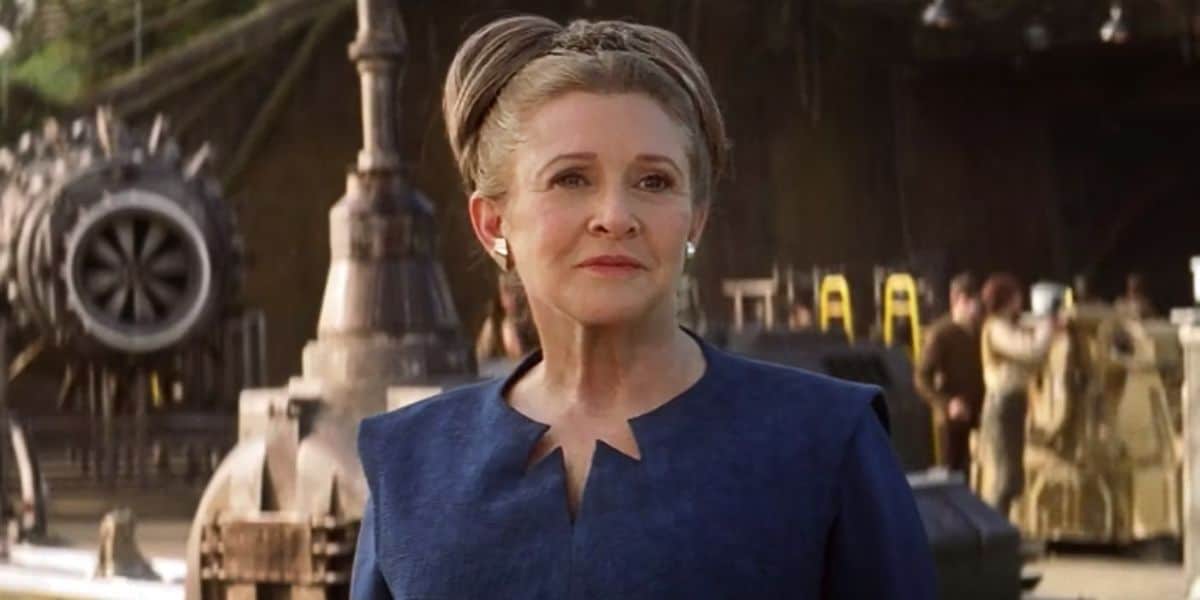
Now, a new piece of information has surfaced that adds to this growing evolution of The Rise of Skywalker ending. “Star Wars: Legacy,” a novel by Madeleine Roux set between The Last Jedi and The Rise of Skywalker, redefines the Tatooine declaration once again — this time by tracing it back to Leia Organa (Carrie Fisher) herself, according to Holofiles via The Direct.
In the book’s final chapter, Rey and Leia repair the shattered Skywalker lightsaber together on the planet Tython. Afterward, Rey tells Leia the weapon “belonged to your family”: “I don’t know if I could have done this without you. And this isn’t just mine; it belonged to your family.”
Leia responds, “Rey, I think you know that it still does.” The chapter, and the novel, ends on a single word: “Belonging.”
Credit: Lucasfilm
That exchange changes the shape of the ending yet again. Rey’s decision to take the Skywalker name is no longer simply a personal declaration of identity, nor only a tribute to Luke’s memory — it becomes a response to an invitation Leia had already extended. According to “Legacy,” Leia welcomed Rey into the family before the events of Episode IX ever took place. When Rey claims the name on Tatooine, she isn’t inventing a connection or conferring a title on herself. She’s accepting one that Leia had already told her she was entitled to.
How the Two Fit Together
Taken separately, each piece of supplemental media addresses a different objection to the ending. The Insight Editions passage answers the “why Skywalker” question by grounding the name in mentorship and values rather than bloodline. “Legacy” answers the “says who” question by establishing that the family itself, through Leia, had already made the offer. Together, they turn a moment once read as abrupt and self-authored into the endpoint of two relationships — with Luke and with Leia — that the films gestured toward but never fully closed the loop on.

Credit: Lucasfilm
Where the Franchise Stands Now
This reassessment is unfolding against real uncertainty about what comes next for the saga. Lucasfilm had not released a Star Wars film since 2019 — a gap that ended in May 2026 with Jon Favreau’s The Mandalorian and Grogu, followed by Shawn Levy’s Star Wars: Starfighter in 2027. Three additional films announced in 2023 — James Mangold’s Dawn of the Jedi, Dave Filoni’s New Republic crossover project, and Sharmeen Obaid-Chinoy’s New Jedi Order, expected to feature Daisy Ridley — have seen little public movement since.
Adding another layer, former Lucasfilm president Kathleen Kennedy confirmed in 2024 that producer Simon Kinberg will oversee a separate, new Star Wars trilogy. Whether Rey factors into that project, into Obaid-Chinoy’s film, or into something else entirely has not been clarified.

Credit: Lucasfilm
What This Means for You
If the Tatooine ending felt unearned back in 2019, these two pieces of supplemental media now give Lucasfilm’s intended reading a textual anchor it didn’t have at release. Between Luke’s posthumous blessing and Leia’s earlier invitation, Rey’s declaration reads less like a name she chose for herself and more like one she was given twice over — first implicitly, then explicitly.
Expect more of this pattern as “Legacy” circulates more widely and as Lucasfilm’s 2026–2027 release slate approaches: the films aren’t being changed, but the story around them keeps getting rebuilt.
How do you feel about the ending of The Rise of Skywalker? Let us know in the comments down below!


