 Disney Tips Your Guide To A Great Disney Vacation

May 26 arrived at Walt Disney World with the kind of energy that only happens when multiple major openings land on the same day, and the parks are collectively holding their breath waiting to see how the demand plays out. Rock ‘n’ Roller Coaster Starring The Muppets opened to the general public at Hollywood Studios. Soarin’ Across America officially debuted at EPCOT. Mickey Mouse Clubhouse Live! launched in the new Walt Disney Studios area. And at Disney’s Animal Kingdom, Bluey’s Wild World at Conservation Station opened its doors for the first time, bringing character experiences, interactive games, and a brand new Australian animal habitat to a park that was already among the most beloved at Walt Disney World for its genuine commitment to animal care and conservation.
The 7 a.m. virtual queue drop for Bluey’s Wild World filled in seconds this morning, as we covered previously. The demand was immediate and overwhelming, as opening days for high-profile family experiences at Walt Disney World tend to be, and the 10 a.m. window that followed was equally competitive for families who found themselves on the wrong side of the instant sellout. The appetite for this experience is real, the virtual queue is the only path in for the foreseeable future, and families who want to see Bluey and Bingo this summer should treat every virtual queue drop with maximum urgency.
But before families race to secure a boarding group at any cost, there is a specific detail about the full Bluey’s Wild World experience worth knowing, because it changes the calculation for one particular group of guests and was not widely publicized ahead of opening day.
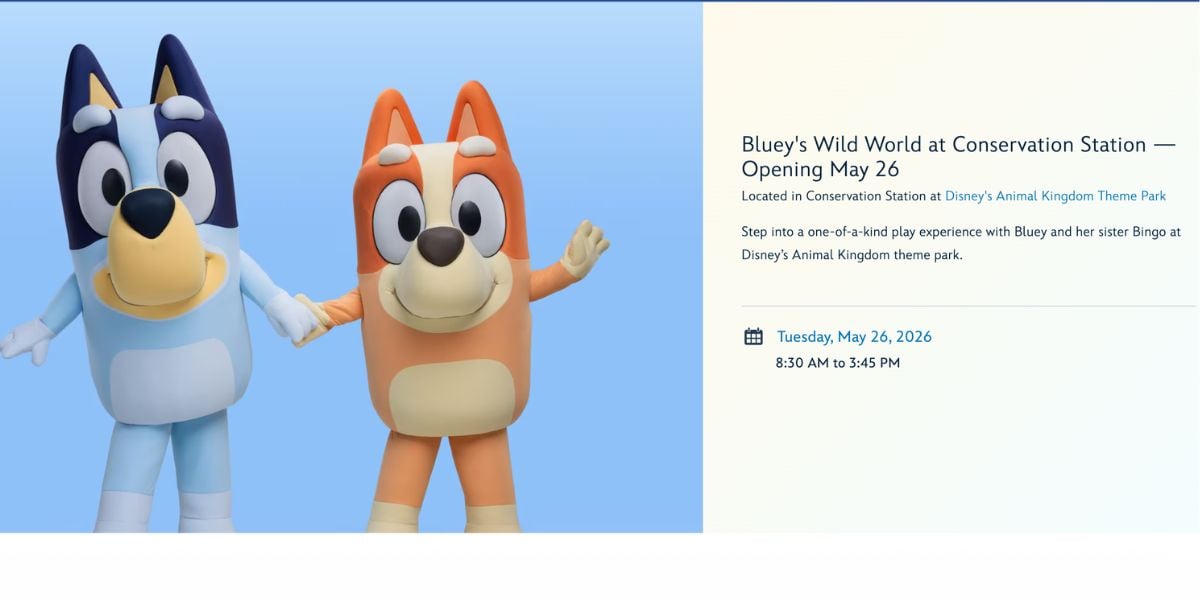
Jumping Junction, the Australian animal experience that replaced the longtime Affection Section at Conservation Station, is not fully open. The kangaroos and wallabies that were brought to Animal Kingdom to inhabit the new space are still acclimating to their environment, and guests cannot currently walk through the habitat or encounter the animals up close. Cast members confirmed this morning that it will be a while before the walkthrough paths are fully operational. The animals have only been in their new habitat since Wednesday, May 20, and yesterday, May 25, was the first time animal keepers were able to walk the path themselves.
At this time, guests can view the kangaroos and wallabies from behind the fencing, but the immersive walkthrough experience that Jumping Junction was designed to offer is not yet available.
What Jumping Junction Was Designed to Be
The Affection Section at Conservation Station was one of Animal Kingdom’s most genuinely beloved low-key experiences for families with young children, a petting zoo area where guests could get close to goats, sheep, and other animals in a hands-on way that felt meaningfully different from the observation-based animal experiences that define most of the rest of the park. Its replacement, Jumping Junction, takes a different approach. Rather than a petting zoo, Jumping Junction is a walkthrough habitat featuring Australian animals, specifically kangaroos and wallabies, the marsupials native to the same country where Bluey and her family live. The geographic and thematic connection between the Bluey franchise and Australian wildlife gives the animal experience a coherence that the Affection Section, beloved as it was, never had with the rest of the park’s programming.
The walkthrough design, with a designated path for guests to follow through the habitat, was intended to create the kind of close proximity to living Australian animals that connects directly to what guests just experienced inside Bluey’s Wild World. That full vision is not yet realized, and based on what cast members shared this morning, it will not be for some time.
New wallabies and kangaroos have arrived at Conservation Station at Disney’s Animal Kingdom! We will be able to walk near them once they acclimate to their new home. 🦘 pic.twitter.com/7qOdPn4Tem
— Drew Smith (@DrewDisneyDude) May 25, 2026
Why This Matters for Families Planning Their Visit
The virtual queue for Bluey’s Wild World is competitive, as this morning’s experience demonstrated. Securing a boarding group requires either waking up before 7 a.m. or being inside Animal Kingdom before 10 a.m. Even then, the window is short enough that missing it by a few seconds is entirely possible. For families who are willing to go through that process specifically because seeing Australian animals up close is a priority for their visit, the current state of Jumping Junction is important context before they invest that effort.
Right now, the kangaroos and wallabies are viewable from outside the fencing. The walkthrough paths that would allow guests to move through the habitat in close proximity to the animals are not accessible. Animal welfare considerations are driving that timeline, and they will not be rushed regardless of demand. The animals have been in their new environment for less than a week. Yesterday was the first time the keeper staff walked the path. Asking guests to do the same before the animals are comfortable with the space and the activity level that a theme park crowd brings would not align with the animal care standards that Animal Kingdom has maintained throughout its history.

For families whose primary motivation for securing a virtual queue boarding group is the Bluey character experience, the interactive games, including Keepy Uppy and Magic Asparagus, and the character appearances from Bluey and Bingo, the current state of Jumping Junction does not change the value of trying for a boarding group. Those elements are fully operational, and the experience delivers what it promises for the Bluey fan in the family.
For families who were specifically anticipating the Australian animal walkthrough as the centerpiece of their visit, waiting until Jumping Junction is fully operational before competing for a virtual queue spot is a reasonable approach. Disney has confirmed that Bluey’s Wild World will continue beyond Cool Kids’ Summer, which means the experience is not going anywhere, and the walkthrough will eventually be available to guests who hold off until the animals have had adequate time to settle into their new home.
The kangaroos and wallabies are there. They are visible. The full experience just needs a little more time.