 Disney Tips Your Guide To A Great Disney Vacation

Starting Sunday, June 28, 2026, Walt Disney World is officially changing the rules of the road. Guests trying to board a resort-bound bus or a Sassagoula River Cruise water taxi from Disney Springs will face strict, mandatory digital checkpoints. To step into the boarding queue, you must present a scanned MagicBand or digital proof of an active on-property resort hotel stay, an advance dining reservation, or a confirmed experience booking.

This permanent operational shift targets a classic, social-media-fueled workaround: the “free parking hack.” For years, day-trippers and local annual passholders dropped their vehicles at Disney Springs for free, hopping onto resort buses to entirely bypass the $35 theme park parking toll.
Yet while closing this loop satisfies corporate accountants and clears the immediate platforms, it is a textbook example of treating a symptom rather than the disease. Restricting non-resort passengers to a single shopping district is a mere band-aid. It does absolutely nothing to fix Disney World’s true systemic emergency: an outdated, overstressed infrastructure system currently trapped in a property-wide construction crunch. Banning people from select buses won’t help ease a transit crisis driven by heavy bulldozers and concrete walls, not local passengers.
The Geometry of a Modern Bottleneck
The corporate narrative suggests that cleaning buses used by local passholders and offsite roamers will automatically optimize transit times. But transportation mathematics tells a different story. Locals aren’t the ones clogging the primary resort-to-park transit loops during morning and evening rush hours; the vast majority park directly at the theme parks using pass benefits.
The real catalyst for ninety-minute bus lines and overflowing platforms is an internal grid pushed past its physical breaking point. Walt Disney World is choking on its own ambitious future. The resort’s transit infrastructure—roads, bypasses, security layouts, and bus terminals—was never engineered to handle modern peak capacities while simultaneously surrendering massive chunks of real estate to construction walls.
When a major peripheral artery is detoured or constricted to accommodate heavy machinery, it causes a cascading delay across the entire fleet.
The Three-Park Construction Squeeze
The 2026 transit crisis is driven by heavy machinery, not local day-trippers. Disney is simultaneously executing massive, multi-year transformations across three out of its four theme parks and a majority of its core resort hotels, placing an unprecedented burden on the remaining usable real estate:
- Magic Kingdom: Landmark land clearing for the “Beyond Big Thunder” expansion, flooding perimeter roads with industrial convoys, and narrowing pedestrian paths.
- Disney’s Animal Kingdom: The total demolition of DinoLand U.S.A. to make way for the “Tropical Americas” land, funneling guest traffic into compressed front-entrance choke points.
- Disney’s Hollywood Studios: Early construction preparation for the newly announced Monsters, Inc. land, constraining shared bus and Skyliner plazas.
- Resort Overhauls: Heavy hotel room reimagining and tower expansions reclaiming guest parking spaces and complicating internal navigation.
When this much physical land is subtracted from the equation, the remaining transit lanes must absorb the overflow. Passenger checks do nothing to solve the reality of a clogged roadway.
The Real Fix: Paving the Path to the Future
Fortunately, Disney leadership knows that filtering lines won’t fix broken geometry. A major portion of the company’s historic $60 billion capital expenditure fund is being funneled directly into massive civil engineering upgrades designed to long-term cure the bottleneck:
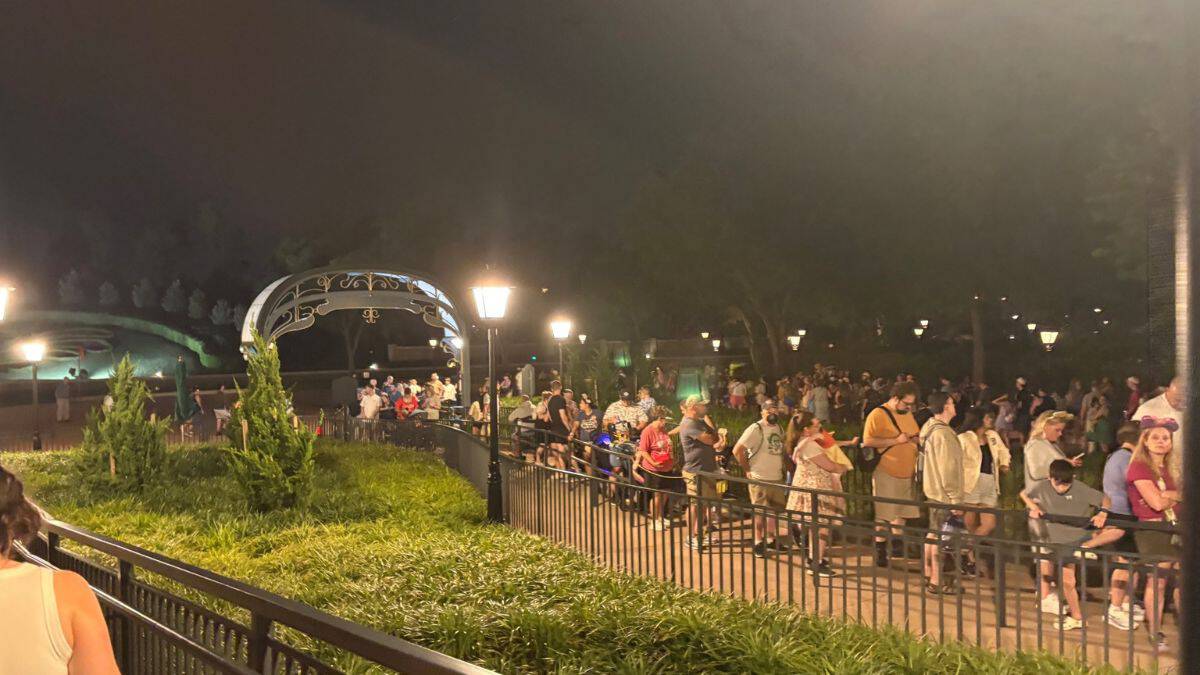
- Dedicated Bus Lanes: Roadwork on World Drive and Osceola Parkway is adding dedicated, fully isolated bus lanes to major corridors, allowing the fleet to bypass guest traffic during peak park-exit hours.
- Hub Overhauls: Structural redesigns are underway to enlarge park-entrance bus loops, allowing articulated buses to load without causing traffic standstills.
- Next-Gen Transit Expansion: Engineering teams should study automated, non-roadway transit extensions to link upcoming park footprints directly to newer resort wings, permanently taking wheels off the pavement.

Filtering passengers at Disney Springs might appear to be an immediate corporate action. Still, until the construction walls come down and the new roads are fully paved, the gridlock will remain an unavoidable reality of the vacation kingdom. You can screen the passengers all you want, but if a bulldozer blocks the road ahead, the bus still isn’t moving.