
 Disney Tips Your Guide To A Great Disney Vacation
For years, the Walt Disney World Resort has been a haven for families seeking an escape from the everyday world’s barriers. But in April 2026, the barrier is the policy itself. What began as a private dispute between a frustrated guest and the theme park giant has officially escalated into a full-scale state investigation.
Following a missed mediation deadline, a formal discrimination complaint regarding Disney’s Disability Access Service (DAS) is now in the hands of the Florida Commission on Human Relations (FCHR). This move marks a significant legal turning point for Disney’s controversial overhaul of its accessibility services—a shift that the Orlando Sentinel notes has significantly “narrowed the options” for thousands of disabled travelers.
The Deadline That Changed Everything
A procedural breakdown triggered the transition from a quiet settlement attempt to a public state probe. Mediation is typically the “last exit” for major corporations to settle discrimination claims before they become matters of public record and subject to state oversight. However, in early April 2026, the deadline passed without an agreement.
Because the parties failed to resolve the matter within the allotted window, the case has been fast-tracked to a formal investigation phase. The Florida Commission on Human Relations now has the authority to dive into Disney’s internal records, interview staff, and determine if the 2024–2025 changes to the DAS system violate the Florida Civil Rights Act.
The Heart of the Complaint: Physical vs. Developmental
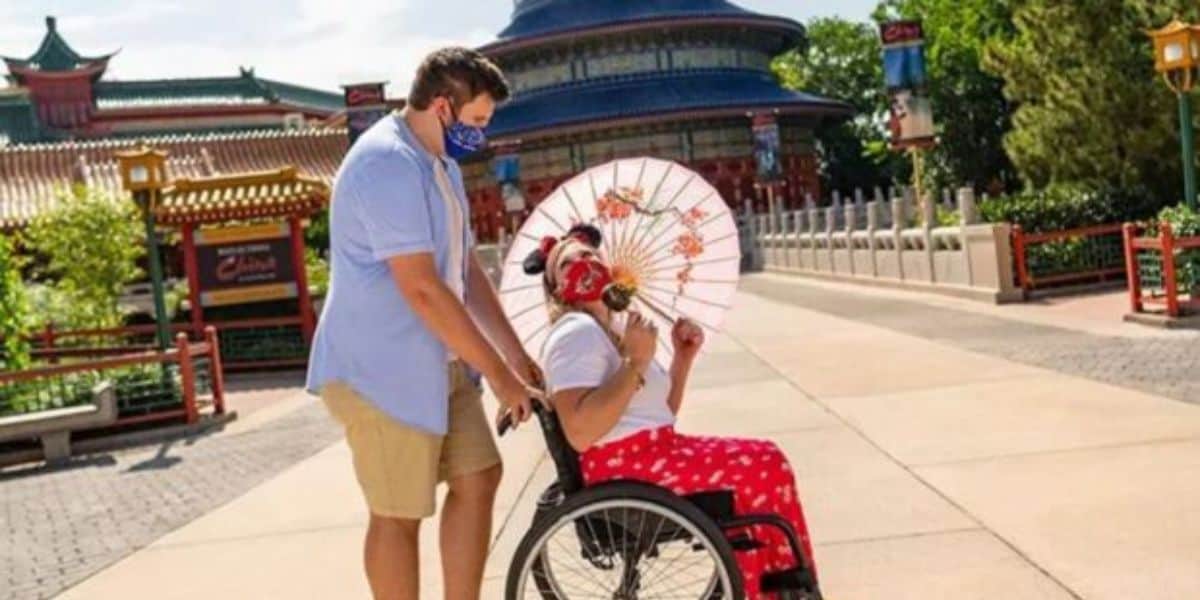
The guest at the center of this probe is a power wheelchair user who argues that Disney’s new, more restrictive DAS criteria constitute illegal discrimination. Under the current rules, DAS is primarily reserved for guests with “developmental disabilities like autism.”

For guests with “invisible” physical conditions or those using complex mobility devices, Disney has shifted its stance. The standard response for these visitors is now to “rent a wheelchair,” “use an ECV,” or utilize a “return-to-queue” feature where the disabled guest waits outside while the rest of their party stands in line.
As a recent commentary in the Orlando Sentinel highlighted, this policy change ignores the medical realities of many visitors. The Orlando Sentinel points out that for a guest in a heavy power wheelchair, attempting to navigate the “geometry” of a standard queue isn’t just difficult—it can be a safety risk. Furthermore, the publication observes that by forcing disabled guests to wait separately from their families, Disney has stripped away the communal joy that is the core of a theme park vacation.
What a State Investigation Means for Disney
Now that the state is involved, the stakes have shifted. This is no longer just about one guest’s experience; it is an audit of Disney’s entire accessibility philosophy. Investigators will likely look at:
- The “Filtering” Process: How third-party contractors determine eligibility during video calls.
- Reasonable Accommodation: Whether telling a guest to “wait on a bench” while their family experiences the attraction meets the legal definition of a reasonable accommodation.
- The Impact of Narrowing Options: Evaluating if the 2024 policy overhaul disproportionately harms guests with non-developmental disabilities.
Disney has consistently defended the changes, stating that the system was being abused and that the high volume of DAS users was impacting wait times for everyone. However, the Orlando Sentinel suggests that in the quest to stop “fakers,” Disney may have built a system that punishes the truly vulnerable.
The Road Ahead
As the Florida Commission on Human Relations begins its work, the eyes of the disabled community are fixed on Orlando. A finding of “reasonable cause” could lead to massive fines, forced policy reversals, and a green light for class-action litigation.

For now, the “Magic” is under a microscope. As the Orlando Sentinel aptly put it, when a company narrows the options for those who already have the fewest, it risks losing the very spirit of inclusion that made it a global icon.
Are you visiting the parks in 2026? Stay informed on the latest FCHR updates and Disney accessibility news.


